



Modern working life is no longer about balance; it is about design.
While people search for a perfect equilibrium between work and private life, research shows that this balance is achieved not only through external policies but also through individuals’ ability to shape their boundaries, values, and priorities. This is where the concept of “crafting” comes in — the art of intentionally shaping your own circumstances in each life domain based on your abilities, needs, and preferences.
However, before we explore how crafting enables fulfilment, it is important to understand what happens when balance breaks down. Work–life imbalance often triggers a spillover effect: when excessive focus on work drains the emotional and physical resources needed for personal life, the resulting strain spills back into work. This cyclical relationship between work and personal life domains has been demonstrated in a meta-analysis by Nohe et al. (2015), showing that strain and imbalance reinforce one another over time. In other words, struggling to maintain balance can reduce well-being, and diminished well-being makes balance even harder to achieve. You can read more about this reciprocal dynamic in the previous ScienceForWork article here.
1. Balance and Integration Are No Longer Enough
For decades, we spoke about work–life balance or work–life integration.
However, both concepts fail to reflect today’s working reality.
- Balance assumes that time and energy can be divided equally between domains, but this idea overlooks the fluid and unpredictable nature of life.
- Integration idealizes the merging of work and personal life, but in an always-connected world, this often fuels burnout and role conflict.
In today’s work, neither model fits. What matters is creating meaningful alignment; not balancing time but shaping life according to what feels right. Success is no longer about “giving equal time to everything,” but about staying true to one’s own priorities. People do not want to fit into systems; they want to be the architects of their own lives. This will become more prominent for each newer generation as the precarity and complexity of work continue to evolve.
2. Crafting: The Active Architect (Not the Passive Guardian) of Balance
Crafting for work-life balance, a relatively new concept, builds on the well-established idea of job crafting, which is theoretically framed within the Job Demands–Resources (JD–R) model. Within this framework, employees proactively adjust their job resources (e.g., autonomy, support) and job demands (e.g., workload, challenges) to better align work with their abilities, needs, and preferences (Tims et al., 2012). Meta-analytic findings show that increasing resources and taking on challenging demands enhance well-being and engagement while reducing burnout and strain, whereas reducing hindering demands tends to lower engagement and satisfaction and increase exhaustion (Lichtenthaler & Fischbach, 2019).
Other forms of crafting beyond the workplace have also been found to yield significant benefits. For example, in a four-week randomized controlled trial, Petrou and de Vries (2023) found that participants who learned to engage in leisure crafting reported greater meaning, self-efficacy, work engagement, and creativity, demonstrating that crafting in one life domain can enhance both personal and work outcomes.
In line with this broader understanding of crafting across life domains, Sturges (2012) defined crafting for work-life balance as “the unofficial techniques and activities that individuals use to shape their own work-life balance.” This seminal study grouped the informal, self-directed crafting strategies employees use into three categories:
- Physical crafting: Managing when, where, and how work is done.
- Relational crafting: Managing relationships at work and at home.
- Cognitive crafting: Redefining and mentally reframing what work–life balance means.
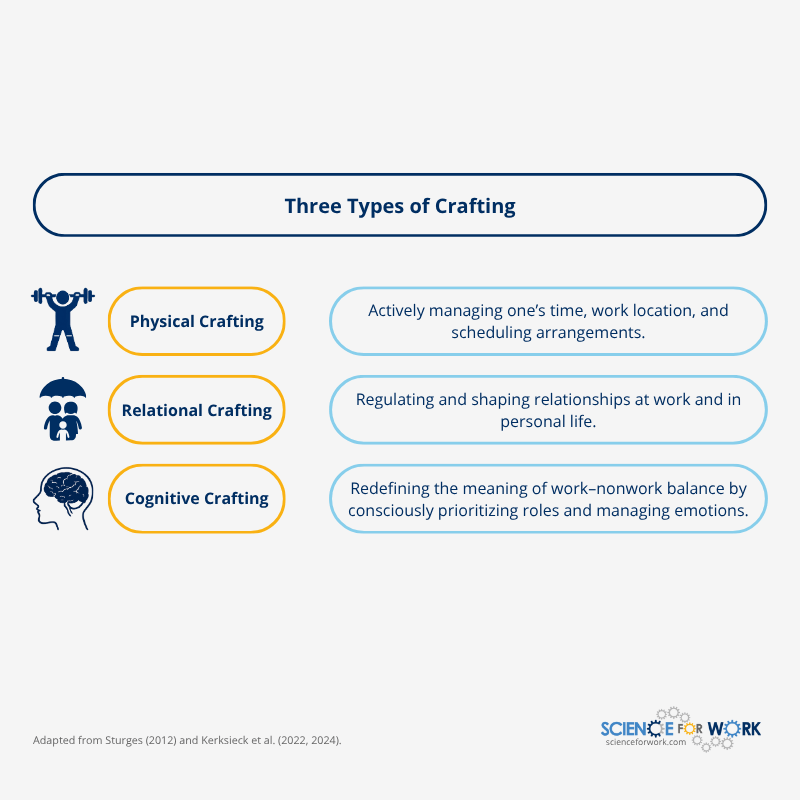
Building on this qualitative study, Kerksieck and colleagues (2022) measured the “work–nonwork balance crafting” with the items such as: “When I must get some personal chores done, I come to work later or go home earlier, if necessary”, “When I am in a bad mood because of work matters, I try not to let this affect my personal environment”, “In some situations, I temporarily emphasize my work (e.g., work more before vacations to get things done).” They found that employees who proactively shape their work–nonwork boundaries, whether in work or nonwork domains, experience higher well-being, stronger engagement, and lower burnout six months later (Kerksieck et al., 2024). According to their results, both job and home resources increased crafting within their own domain. For example, job resources encouraged crafting at work, while home resources supported crafting in private life, but they had no effect across domains. Both job and home demands tended to stimulate crafting within their respective domains, helping individuals manage pressures and protect their functioning in those domains (Kerksieck et al., 2024).
3. The Agentic Perspective: Seeking Fulfillment, Not Just Balance
Khatri and Shukla’s (2022) systematic review similarly proposes an agentic, person-centered perspective on work–life balance. They argue that balance cannot be universally defined; instead, individuals construct their own sense of meaning and fulfillment.
Their analysis of 49 studies highlights nine key personal competencies that enable individuals to craft work-life balance proactively:
- Personal Awareness: Gaining clarity about one’s own beliefs, values, strengths, weaknesses, goals, and intentions in the context of work–life balance.
- Prioritization: Identifying the salience of roles and tasks, both in the short and long term, and setting meaningful, self-concordant goals aligned with one’s values.
- Personal Border Management Style: Recognizing one’s preferred approach to managing the boundaries between work and personal life (integration vs. segmentation) and implementing it actively.
- Managing Tasks: Planning, organizing, and controlling one’s time and energy across multiple roles; setting achievable targets and delegating when necessary.
- Psychological Resources: Preserving and nurturing resources such as self-esteem, internal locus of control, optimism, and self-regulation to remain resilient to work–life challenges.
- Mindfulness: Practicing attention regulation and emotional detachment to stay present, reduce distractions, and derive fulfillment from each role.
- Skillset: Expanding and sharpening one’s skills, including adaptability, cognitive flexibility, critical thinking, and digital literacy, to perform multiple roles effectively.
- Effective Communication: Communicating needs, expectations, and responsibilities clearly in both work and personal domains to minimize conflict and foster understanding.
- Self-Care: Regularly engaging in activities that restore energy and well-being, such as rest, exercise, hobbies, leisure, and relaxation, to prevent burnout and maintain vitality.
Ultimately, these skills lead to a deeper outcome, fulfillment, where life domains feel aligned with one’s inner values.
Across all these studies, a shared message emerges: the goal is no longer to draw a rigid line between work and life, but to redraw that line in ways that reflect personal values, boundary preferences, and life stages. Balance is no longer about standing still; it is about adapting, shaping, and creating harmony like a craftsman working with time, energy, and relationships.
4. The Era of Work–Life Fulfillment
Work-life fulfillment is the psychological and emotional outcome of crafting work-life balance. Khatri & Shukla (2022) define it as “the deep sense of satisfaction and meaning that emerges when one’s life aligns with one’s core values.” In other words, crafting is the method; fulfillment is the result. According to Shukla and Khatri’s (2023) systematic literature review of 64 peer-reviewed studies on work–life fulfillment, experiencing fulfillment across work and life domains is associated with higher life satisfaction, greater positive affect and overall well-being, lower levels of suicide ideation, stronger employee motivation and retention, increased enjoyment and engagement at work, and reduced burnout.
Balance is not a privilege granted by organizations; it is a skill built from within. Those who master it are not only more productive; they are also more authentic, resilient, and fulfilled individuals. In the past, companies offered ready-made solutions: flexible hours, remote work, extra days off. But in today’s complex reality, these policies alone are not enough. True balance is built through personal agency: The power to shape one’s own life.
5 Key Takeaways for Practitioners
- Shift from Policy to Personal Agency: Traditional “work–life balance” programs are no longer sufficient. True alignment is achieved when individuals are empowered to shape their own boundaries, priorities, and roles, rather than merely following company policies.
- Enable Crafting Behaviors: Encourage employees to proactively manage when, where, and how they work (physical crafting), shape relationships across domains (relational crafting), and reframe what balance means to them (cognitive crafting). These behaviors drive well-being, engagement, and lower burnout.
- Strengthen Dual-Domain Resources: Job and home resources both foster crafting within their own domains. HR leaders should design initiatives that enhance autonomy, social support, and recovery opportunities both at work and outside of it.
- Develop Fulfillment Competencies: Support the nine personal competencies that enable proactive balance. These skills create sustainable alignment between personal and professional values.
- Redefine Success as Fulfillment: Balance is no longer about equal time but about meaningful alignment. When employees experience work–life fulfillment, organizations benefit through higher motivation, engagement, and retention.
Trustworthiness score:
This article is based on multiple studies of moderate or above trustworthiness score (Kerksieck et al. 2024; Khatri & Shukla (2022) therefore, we give this article an 80% trustworthiness score. This means that there is a 20% chance that alternative explanations for the effects found are possible.
Learn how we critically appraise studies to assign them a Trustworthiness Score
We aim to provide you only the best available scientific evidence to inform your decisions.
References
Demerouti, E. (2025). Job crafting revisited: Current insights, emerging challenges, and future directions. Annual Reviews of Organizational Psychology and Organizational Behavior, 13, 15.1–15.26. https://doi.org/10.1146/annurev-orgpsych-020924-064242
Kerksieck, P., Brauchli, R., de Bloom, J., Shimazu, A., Kujanpää, M., Lanz, M. & Bauer, G. F. (2022). Crafting work-nonwork balance involving life domain boundaries: Development and validation of a novel scale across five countries. Front. Psychol. 13:892120. https://doi.org/10.3389/fpsyg.2022.892120
Kerksieck, P., Kujanpää, M., de Bloom, J., Brauchli, R., & Bauer, G. F. (2024). A new perspective on balancing life domains: Work-nonwork balance crafting. BMC Public Health, 24(1), 1099. https://doi.org/10.1186/s12889-024-18646-z
Khatri, P., & Shukla, S. (2022). A review and research agenda of work-life balance: An agentic approach. Community, Work & Family, 27(3), 286–320. https://doi.org/10.1080/13668803.2022.2127348
Lichtenthaler, P. W., & Fischbach, A. (2018). A meta-analysis on promotion- and prevention-focused job crafting. European Journal of Work and Organizational Psychology, 28(1), 30–50. https://doi.org/10.1080/1359432X.2018.1527767
Petrou, P., & de Vries, J. (2023). Context-free and work-related benefits of a leisure crafting intervention: A randomized controlled trial. Journal of Leisure Research, 56(1), 123–148. https://doi.org/10.1080/00222216.2023.2244953
Shukla, S., & Khatri, P. (2023). A systematic literature review of work-life fulfillment and future research implications. Indian Journal of Management, 16(6), 8–24. https://doi.org/10.17010/pijom/2023/v16i6/172635
Sturges, J. (2012). Crafting a balance between work and home. Human Relations, 65(12), 1539–1559. https://doi.org/10.1177/0018726712457435
Tims, M., Bakker, A. B., & Derks, D. (2012). The development and validation of the job crafting scale. Journal of Vocational Behavior, 80(2), 173–186. https://doi.org/10.1016/j.jvb.2011.05.009


